

Why do machine tool spindles exclusively use angular contact bearings?
In modern machine tools, the spindle bearing is a key component that ensures machining accuracy and operational stability. Among them, the industry-standard spindle bearing type is almost exclusively the angular contact ball bearing. So why do machine tool spindles favor angular contact bearings? What makes them unique? This article provides a professional analysis from multiple perspectives, including load characteristics, structural advantages, high-speed performance, and machining accuracy.
I. What is an Angular Contact Bearing? Why Is It Closely Linked to Machine Tool Spindles?
An angular contact ball bearing is a type of rolling bearing capable of simultaneously withstanding radial loads and single-direction or bidirectional axial loads. Its core feature is the presence of a contact angle (typically 15°, 25°, or 40°) between the raceways of the inner and outer rings and the rolling elements. This design allows it to maintain excellent dynamic performance even under high-speed rotation.
For machine tools, the spindle is the “heart” of the equipment, responsible for high-speed rotation and high-precision cutting. Angular contact bearings perfectly meet the demanding requirements placed on the spindle.
II. Why Do Machine Tool Spindles Prefer Angular Contact Bearings?
2.1 Able to withstand bidirectional loads, especially axial loads generated by cutting forces
During machining, the cutting force includes not only radial force but also significant axial force. Standard deep groove ball bearings cannot effectively withstand large axial loads, making them unsuitable for spindle structures.
Advantages of angular contact bearings: capable of carrying both axial and radial loads; load capacity can be enhanced through paired or combined installation; suitable for different load directions in vertical and horizontal machining centers.
2.2 Excellent rigidity and preload control
Through paired installation (such as DB back-to-back, DF face-to-face, and DT tandem arrangements), angular contact bearings can be precisely preloaded to eliminate internal clearance, significantly improving the spindle’s dynamic rigidity, suppressing vibration and thermal deformation, and ensuring good surface finish and dimensional consistency.
2.3 Suitable for high-speed operation — the first choice for high-speed spindles
High-speed machine tool spindles often require rotational speeds of 10,000 rpm, 20,000 rpm, or even 60,000 rpm.
Advantages of angular contact bearings: low friction; low heat generation; high permissible speed limit; compatible with oil-air and oil-mist lubrication. These characteristics make them the standard configuration for high-speed spindles.
2.4 High precision levels suitable for precision machining
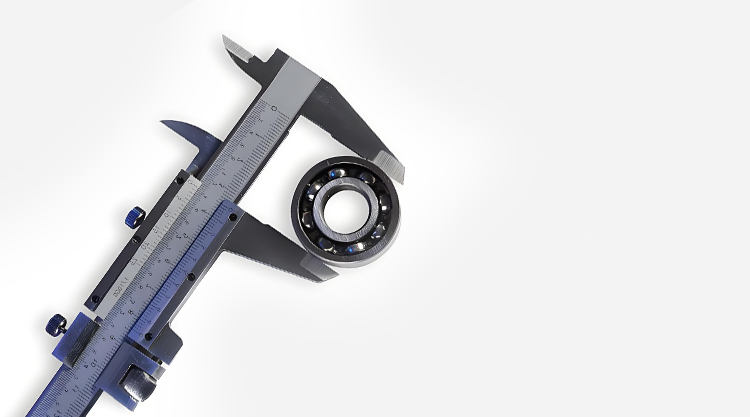
Mainstream P5, P4, and P2 angular contact ball bearings are widely used in high-end machine tool spindles. With strict tolerance control and rotational accuracy reaching the micron level, they fully meet the stringent requirements of aerospace, medical equipment, mold manufacturing, and other fields.
III. Comparison With Other Bearing Types
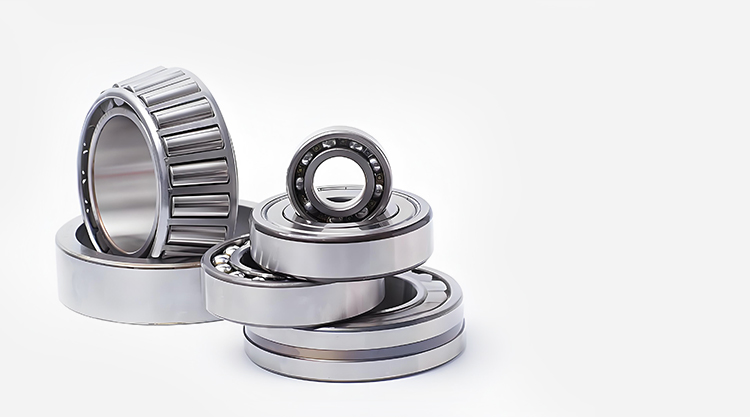
| Bearing Type | Speed Capability | Rigidity | Axial Load Capacity | Precision | Suitable Spindle Applications |
|---|---|---|---|---|---|
| Deep Groove Ball Bearing | Medium | Low | Weak | General | Low-speed, light-load spindles |
| Tapered Roller Bearing | Medium | Very high | Strong | Medium | Heavy-duty machine tools (requires running-in) |
| Angular Contact Ball Bearing | Extremely high | High (adjustable) | Strong (bidirectional) | P2–P5 | High-speed, precision spindles |
As we can see, angular contact ball bearings best match the integrated demands of modern machine tool spindles for high speed, high precision, and high rigidity.
IV. Typical Applications: Which Machine Tool Spindles Must Use Angular Contact Bearings?
Machining center spindles, CNC lathe spindles, grinder spindles, high-speed engraving and milling spindles, precision motorized spindles.
Whenever a spindle requires high speed, high rigidity, high precision, and stability, angular contact bearings are always the optimal choice.
V. Selection Recommendations: How to Match the Right Angular Contact Bearing for a Machine Tool Spindle?
Select contact angle based on speed: higher speeds require smaller contact angles such as 15° or 25° (e.g., 70C, 70AC); heavy cutting may require a larger contact angle such as 40° (e.g., 70B).
Paired arrangement is essential: priority should be given to DB or DF combinations to ensure rigidity and thermal stability.
Pay attention to precision grade: P5 is suitable for standard machining; P4/P2 is recommended for mirror grinding or micron-level machining.
“Why do machine tool spindles rely almost exclusively on angular contact bearings?”—the answer lies in their irreplaceable comprehensive performance advantages: high speed, high rigidity, high precision, bidirectional load capacity, and low heat generation. As smart manufacturing and precision machining continue to advance, angular contact ball bearings have become the “gold standard” of high-end machine tool spindle systems.
-
05 2025.12Comprehensive Guide to Bearing Abnormalities and Their Solutions
This article systematically outlines common types of bearing abnormalities, analyzes their causes, and presents scientific handling methods to help users quickly diagnose issues, extend bearing servic
-
05 2025.12How many types of materials are used for bearings?
This article provides a detailed analysis of common bearing materials and their application characteristics, helping you make informed selections and enhance equipment reliability.
-
05 2025.12Bearing Selection Guide for Hydrofluoric Acid Service Conditions
In industries such as chemical processing, rare earth metallurgy, and petroleum refining, hydrofluoric acid—a highly corrosive medium—imposes stringent demands on the stability of equipment components
-
05 2025.12How to Determine the Amount of Bearing Grease to Apply?
In mechanical equipment maintenance, the amount of grease applied to bearings is a critical factor affecting bearing lifespan, operational efficiency, and equipment stability.